
Discover why RYAN AEROSPACE is seen as a pioneer and global leader in virtual and mixed reality flight simulation training solutions...

US AIR FORCE
PILOT TRAINING TRANSFORMATION
new stuff...
reimagining how pilots train...
Before a US Air Force pilot ever steps into the cockpit of a jet, they need to build the muscle memory, procedural instinct, and situational awareness that keep them alive under pressure. For decades, that training relied on purpose-built simulators: expensive, room-sized systems that took years to field and even longer to update.
The Pilot Training Transformation (PTT) program set out to change that, replacing legacy simulation with something radically more accessible: virtual reality training devices that could be deployed at scale, upgraded as technology advanced, and put directly into the hands of every pilot who needed them. Vertex Solutions won the contract in 2020 to deliver on that vision for the US Air Force. To build it, Vertex turned to RYAN AEROSPACE.
the challenge...
Virtual reality training hardware existed in labs and prototypes long before PTT. What didn't exist was a way to manufacture it to defense-grade standards, at fleet scale, fast enough to matter. The US Air Force needed more than 300 Immersive Training Devices (ITDs), each one durable enough for daily use on active flight lines, consistent enough that a pilot trained on one performed identically on another, and built with enough headroom to accommodate hardware and software upgrades for years to come.
That last requirement was the quiet, critical detail. A training device that could only ever be a virtual reality trainer would eventually be a dead end. The US Air Force needed a platform, not just a product.
the solution...
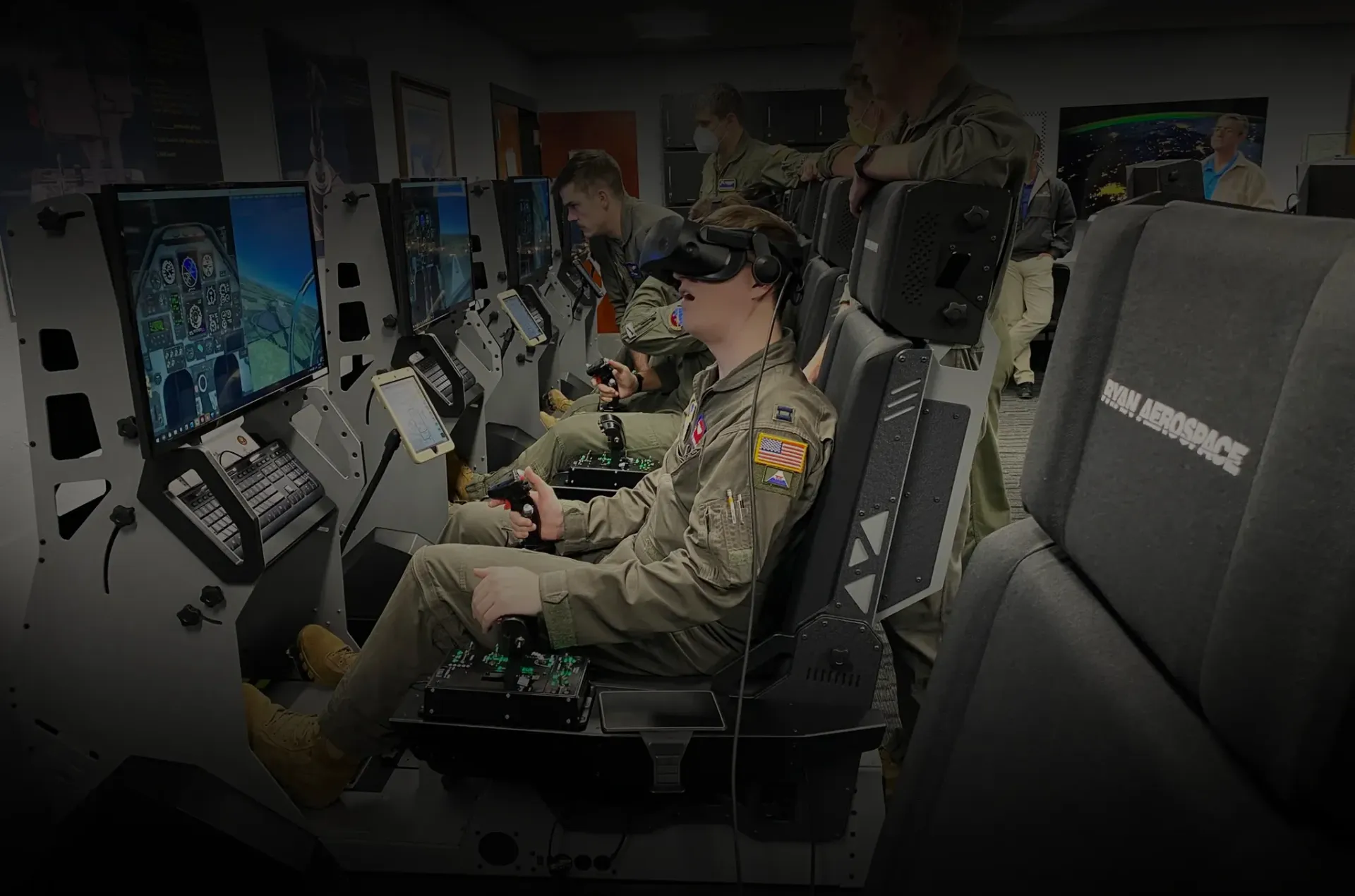
RYAN AEROSPACE took on the engineering and manufacturing of the ITD fleet itself: designing, building, and delivering more than 300 virtual reality Immersive Training Devices to the US Air Force. Every device was engineered from the ground up to survive the realities of a working flight line, not a showroom floor, while still delivering the fidelity a pilot needs to trust their training.
At fleet scale, that combination of ruggedness, consistency, and modularity is what let PTT succeed where lab prototypes couldn't: hardware good enough, and reproducible enough, to put in front of every pilot who needed it.
The Immersive Training Device (or ITD) was born and delivered at scale.
the impact...
Pilot Training Transformation gave the US Air Force something it hadn't had before: a fleet of virtual reality training devices built to defense-grade standards, deployed at genuine scale, and engineered to grow with the mission rather than age out of it.
For the US Air Force, it meant a faster, more flexible, more cost-effective way to build pilot proficiency, backed by hardware that held up under real operational use. For RYAN AEROSPACE, PTT became the foundation for everything that followed: the delivery record, the manufacturing discipline, and the modular engineering approach that the US Air Force would later call on again for Fighter Bomber Fundamentals, when it was time to take that same fleet from virtual reality to mixed reality.
