
Discover why RYAN AEROSPACE is seen as a pioneer and global leader in virtual and mixed reality flight simulation training solutions...

US AIR FORCE
MULTI - PLACE MIXED REALITY (MPMR)
new stuff...
multi-place mixed reality MPMR...
RYAN AEROSPACE helped the US Air Force move from single-seat to multi-crew mixed reality training - training a crew, not just a pilot.
Every virtual and mixed reality training device the US Air Force had fielded before 2022 shared the same limitation: one seat, one student, one set of controls. That works for procedural training on a fighter or trainer jet, but it breaks down the moment a mission depends on two people in the same cockpit working together.
Rotary-wing training is exactly that mission. The 19th Air Force's Helicopter Training Next program needed a way to bring instructor and student, or two student crew members, into the same simulated aircraft at the same time, coordinating on the same controls, without the cost and lead time of a traditional Weapon Systems Trainer. The Defense Innovation Unit selected Vertex Solutions in November 2022 to build it: the Multi-Place Mixed Reality (MPMR) Flight Simulator. Vertex turned to RYAN AEROSPACE to help engineer it.
the challenge...
Every mixed and virtual reality training device the US Air Force had fielded to that point, through Pilot Training Transformation and the T-38 and F-16 mixed reality trainers that followed, was built around a single seat. That was the right design for procedural, single-pilot training, but it could not answer the question Helicopter Training Next was built to solve: how a student and an instructor, or a two-person crew, train together, physically side by side, with both sets of hands on real controls.
The Defense Innovation Unit structured the program under an Other Transaction Authority contract built for speed rather than the two-to-three-year timelines of traditional defense procurement: a working prototype within 12 months, and a full five-device solution within 19. It also demanded a platform that would not be a one-off. The initial requirement centred on the TH-1H, the US Air Force's primary rotary-wing trainer, but the device had to be reconfigurable enough to extend to other fixed- and rotary-wing aircraft as the Air Force's needs grew.
the solution...
RYAN AEROSPACE brought the manufacturing discipline it had already built on Pilot Training Transformation and Fighter Bomber Fundamentals to a genuinely new engineering problem: a cockpit built for two.
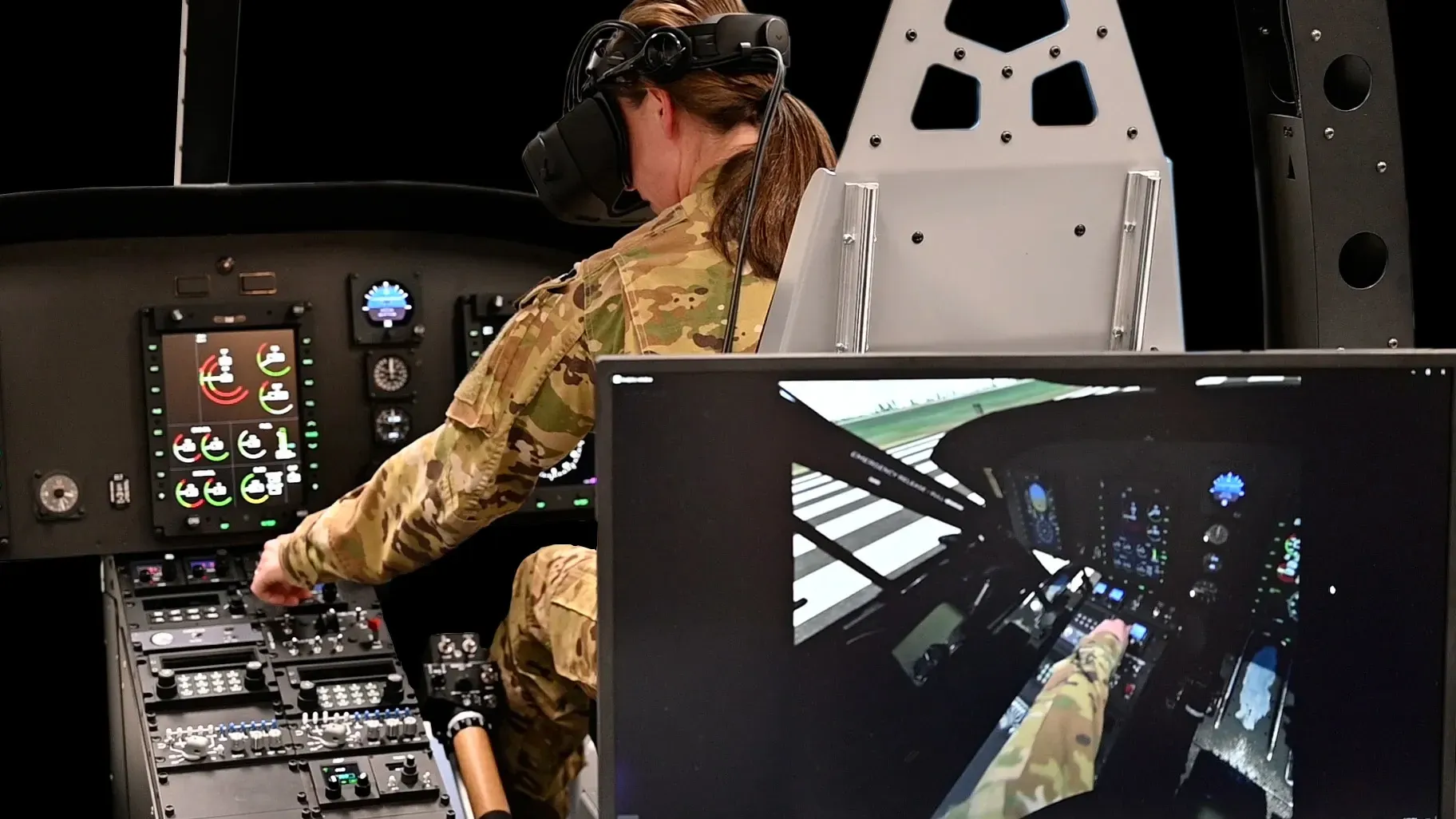
The result was the MPMR Dual Control TH-1H, a reconfigurable multi-crew mixed reality flight simulator pairing physical avionics panels and dual flight controls, matched to the real TH-1H cockpit, with Varjo's cockpit-optimised mixed reality headsets. Where earlier devices placed one student inside a generated environment, the MPMR simulator puts a full crew inside it together, each seeing and reaching for the same physical switches, panels, and controls as the person beside them, with the visual world blended in around them.
The architecture was built to be reconfigured, not replaced, extending the same modular philosophy RYAN AEROSPACE established on Pilot Training Transformation to a multi-crew platform, so the Air Force could adapt it to other rotary- and fixed-wing types without fielding an entirely new device each time.
19th Air Force, Air Education and Training Command set the requirement through its Helicopter Training Next program, aimed at training more pilots, more effectively, at lower cost, to help address the Air Force's pilot shortage.
Vertex Solutions won the program and led its overall development and delivery to the US Air Force.nRYAN AEROSPACE engineered the dual-control, multi-crew hardware itself, the physical cockpit every crew trains in together.
Varjo supplied the mixed reality headsets, purpose-built for cockpit environments with high-resolution pass-through cameras tuned for close-range instrument reading.
It is another chapter in RYAN AEROSPACE's ongoing partnership with Vertex Solutions on US Air Force training modernisation, and proof that Australian aerospace engineering can be trusted with a harder problem each time it is asked.
Every physical element, seats, cyclic, collective, pedals, switches, and panels, had to be duplicated, positioned, and calibrated so that two independently tracked headsets rendered a consistent shared environment for both occupants at once. And because Helicopter Training Next needed the device to reach beyond the TH-1H over time, that dual-crew hardware had to be engineered for reconfiguration from the outset, not bolted on as an afterthought once the first airframe was done.
the impact...
The MPMR Flight Simulator gives the US Air Force something none of its earlier XR training devices could offer: genuine crew training, not just individual procedural repetition, in a device fielded in months rather than years and priced to save several times the fielding, modification, and sustainment cost of a traditional Weapon Systems Trainer.
For RYAN AEROSPACE, MPMR is proof that the manufacturing discipline built on single-seat programs like Pilot Training Transformation and Fighter Bomber Fundamentals scales to a harder, multi-crew engineering problem, and that the US Air Force trusted RYAN AEROSPACE to solve it.
