Discover why RYAN AEROSPACE is seen as a pioneer and global leader in virtual and mixed reality flight simulation training solutions...

US ARMY
AVIATOR TRAINING NEXT (ATN)
new stuff...
a spirit of piloneering...
Every US Army helicopter pilot begins their career in Initial Entry Rotary Wing (IERW) training, the foundation course where raw aptitude becomes real flying skill. For decades, building that skill meant one thing above all else: stick time, in the aircraft, which is exactly the resource that is hardest to expand and most expensive to fly.
The US Army Aviation Center of Excellence (USAACE) at Fort Rucker set out to find a better way, drawing on emerging lessons from the US Air Force's own experiments with virtual reality flight training.
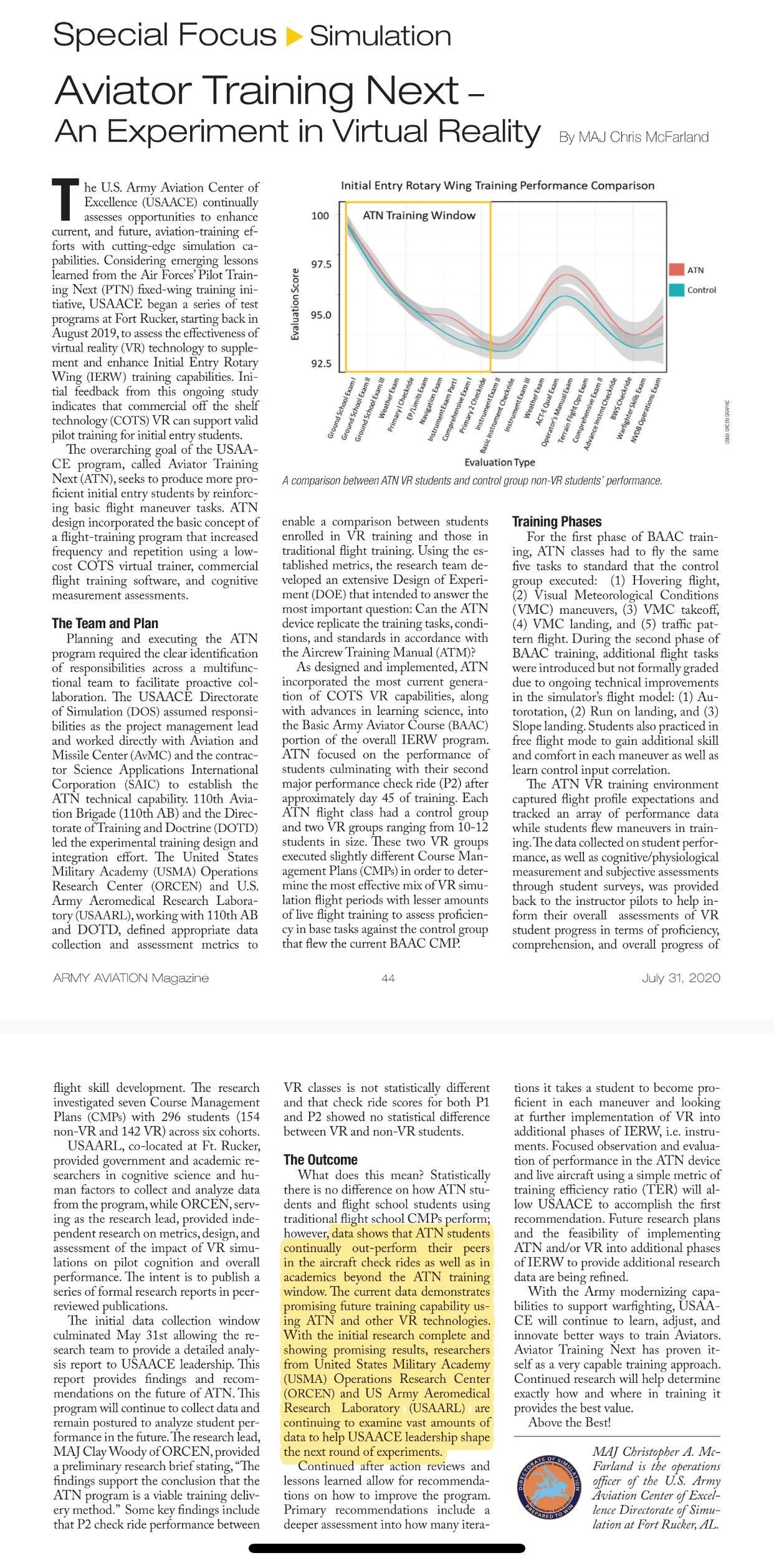
The result was Aviator Training Next (ATN): the first serious, at-scale attempt anywhere to train helicopter pilots using virtual reality, and a rigorous, data-driven test of whether the technology could genuinely supplement and enhance how Army aviators are trained. RYAN AEROSPACE, engaged through SAIC, was chosen to build the hardware that made the experiment possible, and in doing so helped pioneer a training approach that had never been attempted at this scale for rotary wing aviation.
the challenge...
USAACE's ambition for ATN was specific and disciplined: reinforce basic flight maneuver tasks by increasing the frequency and repetition of practice, using low-cost commercial off-the-shelf (COTS) virtual reality hardware, commercial flight training software, and cognitive measurement assessments, all built into the Basic Army Aviator Course (BAAC) portion of IERW.
That ambition came with a hard requirement. This wasn't a demonstration or a proof of concept; it was formal research, run under a Design of Experiment methodology, built to answer one uncompromising question: could a virtual reality device actually replicate the training tasks, conditions, and standards defined in the Army's own Aircrew Training Manual, closely enough to trust it with real student pilots? Delivering that meant the underlying VR hardware had to be reliable and consistent enough, across every device and every cohort, to survive scientific scrutiny.
the RYAN AEROSPACE solution...
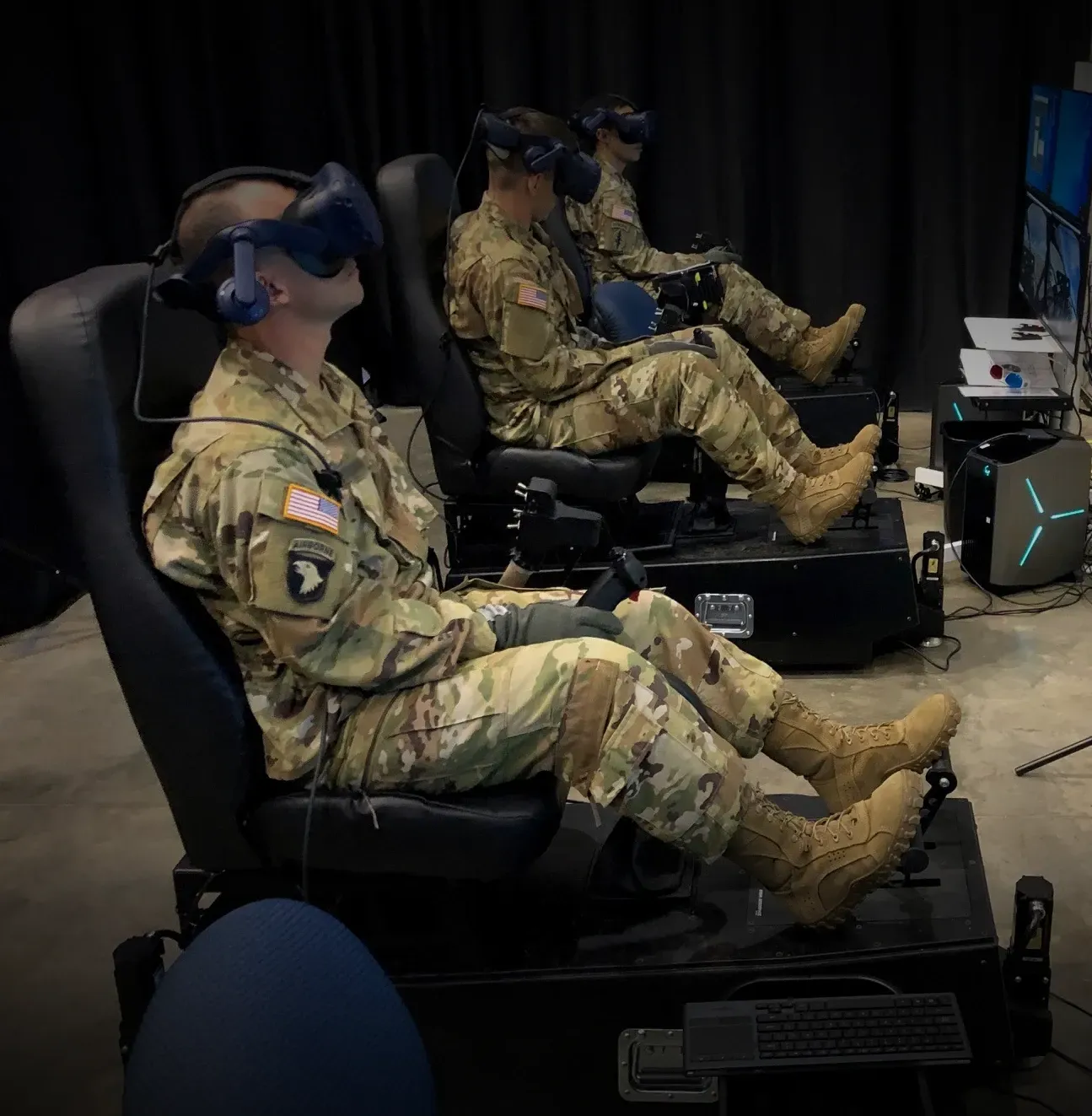
RYAN AEROSPACE, engaged through SAIC, the contractor USAACE's Directorate of Simulation partnered with to establish the ATN technical capability, designed and delivered around 40 units of its HELIMOD Mark III virtual reality training device to support the program at Fort Rucker.
There was no established playbook to follow. Rotary wing flight, with its constant, simultaneous control inputs across cyclic, collective, and pedals, is a fundamentally harder motion problem to replicate convincingly in virtual reality than fixed wing flight, and no one had yet tried to field VR helicopter training at genuine program scale. The HELIMOD Mark III was RYAN AEROSPACE's answer: a purpose-built platform engineered specifically to capture the fidelity of helicopter flight controls, and to do so consistently enough to stand up to formal Army research.
Every device had to perform identically to the next. With flight classes split across a control group and multiple VR training groups, each running different Course Management Plans to find the most effective mix of virtual and live flight training, the integrity of the entire study depended on the hardware behaving the same way for every student, every cohort, every time. That consistency is what let USAACE's research team isolate the true effect of VR training rather than variation in the equipment itself. The HELIMOD Mark III (picutred below) provided a robust and realistic platform designed to advance aviators through flight school more efficiently and effectively than ever before.
the impact...
The results validated the entire premise of ATN. Statistically, VR-trained students performed on par with their traditionally trained peers on the standard check rides, exactly the baseline the Army needed to see. But the more striking finding came afterward: ATN students went on to consistently out-perform their peers in later aircraft check rides and academics, beyond the ATN training window itself. Further, the students that trained on the RYAN AEROSPACE HELIMOD Mark III were given 40% LESS training in the real helicopter than their peers (the control group).
MAJ Clay Woody, the research lead from ORCEN, put it plainly: "The findings support the conclusion that the ATN program is a viable training delivery method." For RYAN AEROSPACE, that conclusion rests on hardware performing exactly as it needed to, class after class, cohort after cohort, under the exacting conditions of a formal Army research program, and it stands as proof that the HELIMOD Mark III didn't just take part in the first at-scale trial of VR helicopter training, it helped prove the concept could work.